ADA Parking Lot Compliance in Kansas City: What Property Managers Need to Know
ADA parking lot compliance is not optional. If you own or manage a commercial property in Kansas City, federal law requires your parking lot to meet specific accessibility standards laid out by the Americans with Disabilities Act. Falling short does not just mean a fine. It opens the door to lawsuits, DOJ investigations, and real financial damage. The good news is that most compliance issues are straightforward to fix once you know what to look for.
At Platinum Paving, we have completed over 530 commercial paving projects across the KC metro, and ADA compliance work is one of the most common requests we get from property managers. Here is a plain-English breakdown of what your parking lot actually needs to stay compliant.
What Are the Basic ADA Parking Lot Requirements?
Every commercial parking lot open to the public must provide a minimum number of accessible parking spaces, and those spaces must meet specific dimensional and design standards. The three core requirements are accessible spaces sized correctly, van-accessible spaces with extra width, and access aisles adjacent to every accessible space.
Standard accessible spaces must be at least 8 feet wide. Van-accessible spaces must be at least 11 feet wide, or 8 feet wide with an 8-foot access aisle. Every accessible space needs an adjacent access aisle that is at least 5 feet wide, marked with diagonal hash lines so nobody parks in it. These aisles are what allow wheelchair users and people with mobility devices to actually get in and out of their vehicles.
Accessible spaces must also be located on the shortest accessible route to the building entrance. You cannot stick them in the back corner of the lot and call it good. They need to be closest to the main entry, on level ground, connected to an accessible route with no steps or abrupt level changes.
How Many ADA Spaces Does Your Parking Lot Need?
The number of required accessible spaces is based on the total number of parking spaces in your lot. The ADA sets clear minimums, and there is no guesswork involved. Here is the breakdown:
| Total Spaces in Lot | Required Accessible Spaces |
|---|---|
| 1 to 25 | 1 |
| 26 to 50 | 2 |
| 51 to 75 | 3 |
| 76 to 100 | 4 |
| 101 to 150 | 5 |
| 151 to 200 | 6 |
| 201 to 300 | 7 |
| 301 to 400 | 8 |
| 401 to 500 | 9 |
| 501 to 1,000 | 2% of total |
| 1,001+ | 20 plus 1 per 100 over 1,000 |
For every six accessible spaces (or fraction thereof), at least one must be van-accessible. So if your lot has 100 spaces, you need four accessible spaces, and at least one of those four must be van-accessible with the wider aisle or wider space.
If your property has multiple buildings or entrances, accessible spaces need to be distributed so they serve each entrance, not clustered in one spot.
What Makes an ADA-Compliant Ramp?
Curb ramps are where many Kansas City parking lots fall out of compliance. An ADA-compliant ramp must have a maximum running slope of 1:12, meaning for every inch of rise, you need at least 12 inches of ramp length. A 6-inch curb requires a ramp that is at least 6 feet long.
The ramp must be at least 36 inches wide, with a level landing area at the top and bottom. Top landings need to be at least 36 inches long in the direction of travel. Bottom landings at the street or lot level must also be level so a wheelchair does not roll into traffic.
Detectable warning surfaces are required at the base of every curb ramp where it meets a vehicular way. These are the yellow or red truncated dome panels you see at crosswalks. They alert people with visual impairments that they are transitioning from a pedestrian area to a vehicle area. Missing or damaged detectable warnings are one of the most common violations we see on KC properties.
Ramp surfaces must be stable, firm, and slip-resistant. Cracked, heaved, or crumbling concrete ramps do not meet the standard, period. If the surface has deteriorated to the point where a wheelchair cannot travel smoothly, the ramp needs repair or replacement.
What Signage Is Required for ADA Parking Spaces?
Every accessible parking space must have a sign displaying the International Symbol of Accessibility. The sign must be mounted on a post or wall so that it is visible even when a vehicle is parked in the space. This means ground-painted symbols alone do not count as signage. You need both the pavement markings and an upright sign.
Van-accessible spaces require an additional sign below the accessibility symbol that reads "Van Accessible." Both Kansas and Missouri also require language on or near the sign indicating the fine for unauthorized parking in accessible spaces.
Sign mounting height matters. The bottom of the sign should be at least 60 inches above the ground so it is clearly visible above vehicle rooflines. Signs that are too low get blocked by parked cars and trucks, which defeats the purpose.
Faded, missing, or broken signs are a compliance violation. If your signs have been hit by a plow, faded by the sun, or knocked over, replacing them is one of the simplest and cheapest fixes you can make.
What Are the Penalties for Non-Compliance in Kansas and Missouri?
The financial exposure from ADA non-compliance is serious. Under federal law, first-time violations can carry civil penalties up to $75,000. Subsequent violations can reach $150,000. These are penalties paid to the government, separate from any damages awarded in a private lawsuit.
Private lawsuits are the bigger risk for most property owners. Under the ADA, individuals can sue for injunctive relief, meaning a court can order you to make your lot compliant at your expense, and the plaintiff's attorney fees get added to your tab. In Missouri and Kansas, these lawsuits have become increasingly common. There are law firms that specifically target non-compliant properties, sending individuals to document violations and then filing suit.
The Department of Justice also conducts enforcement actions, particularly against larger properties like shopping centers, apartment complexes, and medical facilities. A DOJ investigation is expensive and disruptive even if you ultimately reach a settlement.
In both Kansas and Missouri, unauthorized parking in accessible spaces carries fines ranging from $50 to $500 depending on the jurisdiction. But as the property owner or manager, your liability is not about who parks where. It is about whether the lot itself meets the standards. If you do not have enough spaces, proper ramps, or correct signage, you are the one on the hook.
How Do You Bring an Older Parking Lot Into Compliance?
Most older Kansas City parking lots were built before current ADA standards were in place, or they have deteriorated to the point where originally compliant features no longer meet the requirements. The fix usually involves three categories of work: ramp installation or repair, re-striping, and signage upgrades.
ADA ramp installation is the most involved piece. If your lot has raised curbs without ramps, or ramps that are too steep or too narrow, new concrete ramp construction is required. This means cutting out the existing curb, pouring a properly sloped ramp with the right landing areas, and installing detectable warning panels. On a typical commercial property, ramp work can be completed in a few days without shutting down the entire lot.
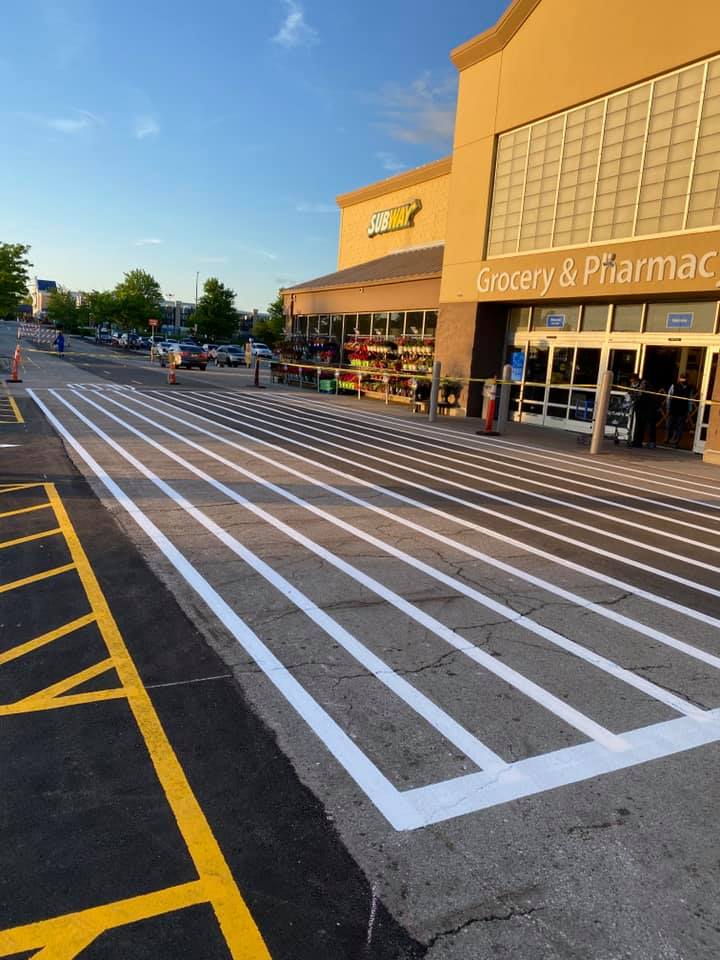
Re-striping involves laying out accessible spaces at the correct dimensions, painting access aisles with proper hash marks, and adding the International Symbol of Accessibility to the pavement surface. If your lot is being resurfaced or sealcoated, that is the ideal time to re-stripe for compliance since you are starting with a fresh surface.
Signage upgrades are the fastest and most affordable piece. Post-mounted signs with the accessibility symbol, van-accessible designations, and fine warnings can be installed in a single day across most properties.
A compliance audit is the smart first step. Walk the lot with a measuring tape, or better yet, have a contractor who knows ADA standards do it for you. Document every space, ramp, sign, and route. Once you know where the gaps are, you can prioritize the work and get it done.
Why Should KC Property Managers Address ADA Compliance Now?
Proactive compliance is always cheaper than reactive compliance. Fixing a ramp before someone files a complaint costs a fraction of what it costs to fix it after a lawsuit lands on your desk. Property managers who stay ahead of ADA requirements also protect their tenants and their property's reputation.
Kansas City's commercial real estate market is competitive. Tenants pay attention to lot conditions, and retail tenants in particular know that ADA violations can trigger lawsuits that name both the landlord and the tenant. A well-maintained, fully compliant parking lot signals that you manage your property professionally.
Spring and summer are the best times to schedule ramp pours, re-striping, and signage work in the Kansas City area. Concrete needs warm temperatures to cure properly, and line striping paint adheres best in dry conditions above 50 degrees. If you know your lot has compliance gaps, getting on a contractor's schedule now means the work gets done before the busy season peaks.
Get Your Parking Lot Compliant With Platinum Paving
Platinum Paving handles every piece of ADA parking lot compliance for commercial properties across the Kansas City metro. Ramp construction, re-striping, signage installation, and full compliance audits -- we do it all in-house with our own crew. No subcontractors, no finger-pointing, and a 1-year warranty on all workmanship and materials.
If you are not sure whether your lot meets current ADA standards, call us at (913) 701-6044 for a free on-site assessment. We will walk the lot, document what needs attention, and give you a clear plan to get compliant. You can also request a free estimate online and we will get back to you within one business day.
One contractor for every parking lot need -- we install it, maintain it, and keep it compliant.